
SENTINELA
Pioneer in landslide prevention

THE CHALLENGE
Sentinela was developed to transform the way the Civil Defense of Minas Gerais assesses slope risks and prevents natural disasters. Through this app, we integrated innovative technologies that support continuous monitoring of vulnerable areas across the state, enabling a fast and effective response to adverse situations.
Our mission is to contribute to the safety of Minas Gerais communities, making the assessment process more accessible and efficient with an intuitive system and specialized geolocation and real-time image capture tools.

PRECISE GEOLOCATION
Captures the exact location of vulnerable slopes with high-precision GPS, mapping critical areas in real time to speed up the deployment of response teams.

INSTANT CAPTURE
Photos and videos in real time document risk conditions immediately, creating a complete visual history for technical analysis and official emergency reports.

SMART ALERTS
Instant push notifications to teams when anomalies are detected, ensuring a fast response even in remote areas or adverse weather conditions.

AUTOMATED ANALYSIS
AI evaluates images and geographic data to classify risk severity, prioritize interventions and suggest preventive actions based on historical patterns.
IMAGINING THE SCREENS

PRECISION

EFFICIENCY

ACCESSIBILITY
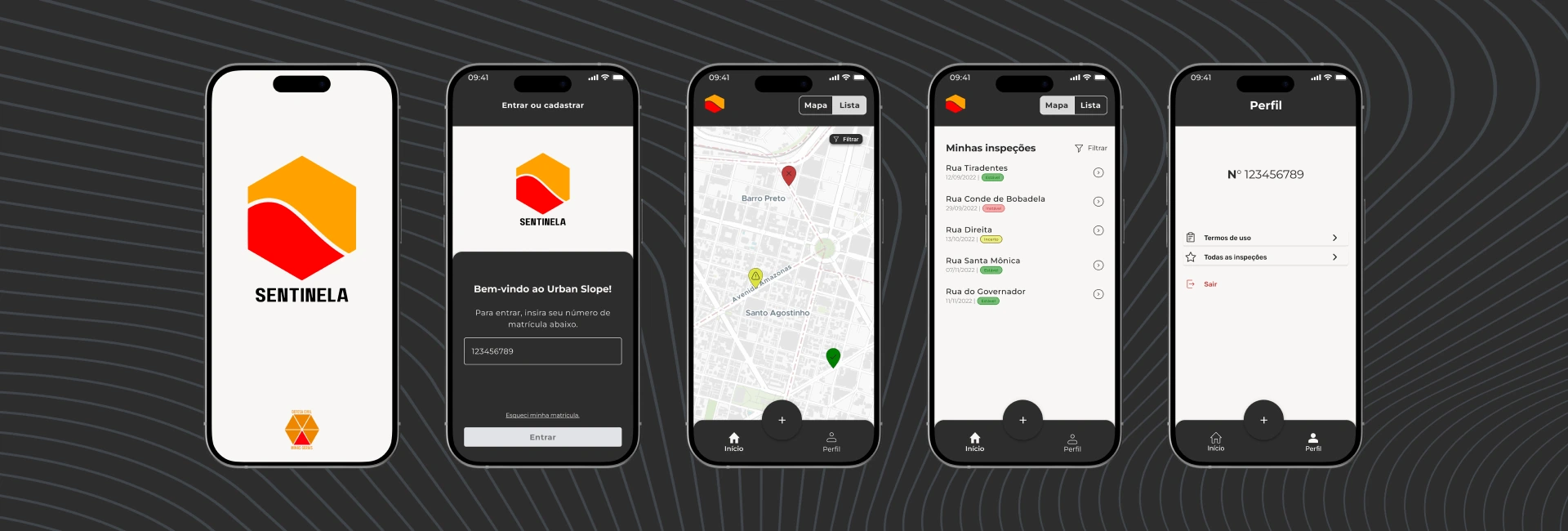
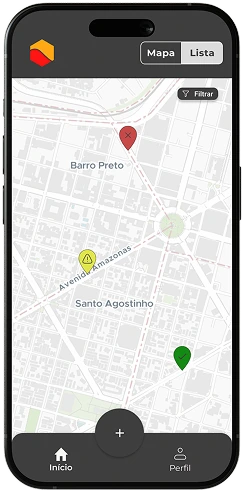
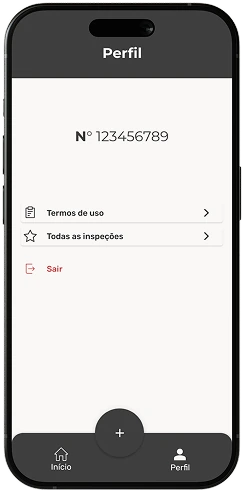
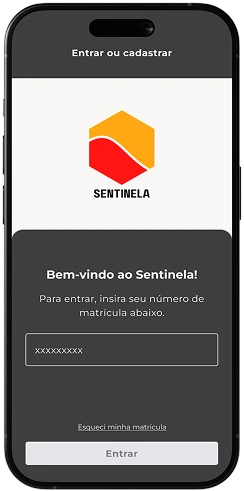
For Sentinela, precision is essential, since the app must provide reliable slope-risk data for Civil Defense. That is why the screens were designed to display information clearly, accurately and efficiently, with maps and charts that are easy to interpret. Accessibility was also a priority, so that different users — including those with little familiarity with technology — can navigate with ease.
Style guide

Graphite gray
#2E2D2D
Primary font
Montserrat
Letters:
Aa Bb Cc
Numbers:
012345
BUILDING THE PROJECT
Development was oriented to ensure that slope-risk data would be processed and presented efficiently. The platform was built to handle large volumes of data in real time, providing a fast and secure system for geospatial monitoring and analysis.
figma
flutter
firebase
The creation of Sentinela's interfaces started in Figma, where we developed visual prototypes that reflected the simplicity and efficiency required for field use. With Figma, we mapped the entire user journey, created intuitive flows and visually validated every interface element, ensuring a cohesive design focused on the user experience.

THE IMPORTANCE BEHIND SENTINELA
Sentinela uses statistical models and machine-learning algorithms to classify the stability of urban slopes based on data collected in the field. Each inspection turns technical measurements into an objective risk analysis. Developed to support Civil Defense teams in the state of Minas Gerais, Sentinela helps mitigate risks in vulnerable urban areas, strengthening the government's preventive action.

DIFFERENTIALS

APPLIED ARTIFICIAL INTELLIGENCE
Linear Regression and Multivariate Statistics models turn field variables into an objective risk classification.

OFFLINE ANALYSIS
Works completely offline in remote areas. Synchronization happens automatically when a connection is available.

GEOREFERENCED MONITORING
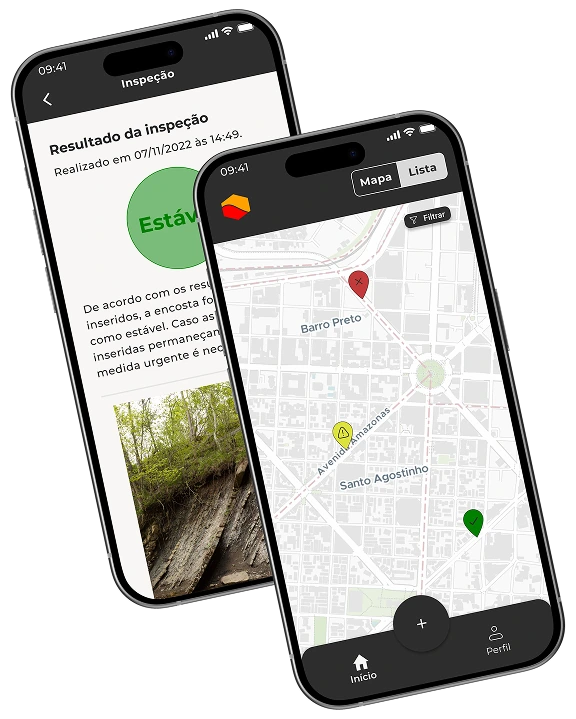
Map visualization of inspected areas, enabling traceability and continuous monitoring of tracked slopes.

MODULAR AND SCALABLE PLATFORM
Architecture adaptable to different contexts, with the possibility of creating new specialized modules.
HOW SENTINELA TRANSFORMS MEASUREMENTS INTO DECISIONS
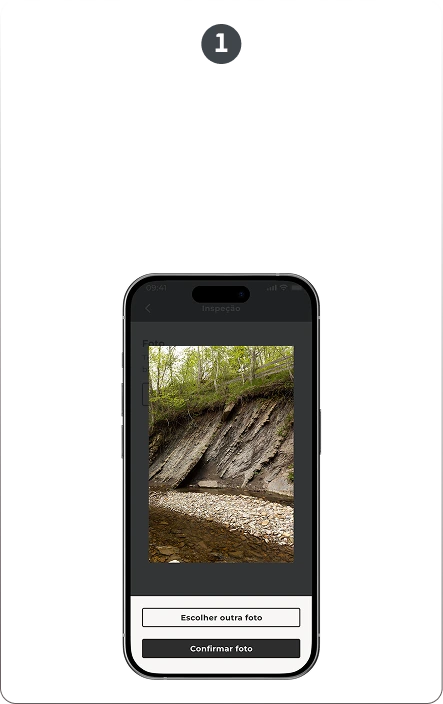
Visual record
The agent captures the slope in the field with technical photos of local conditions.
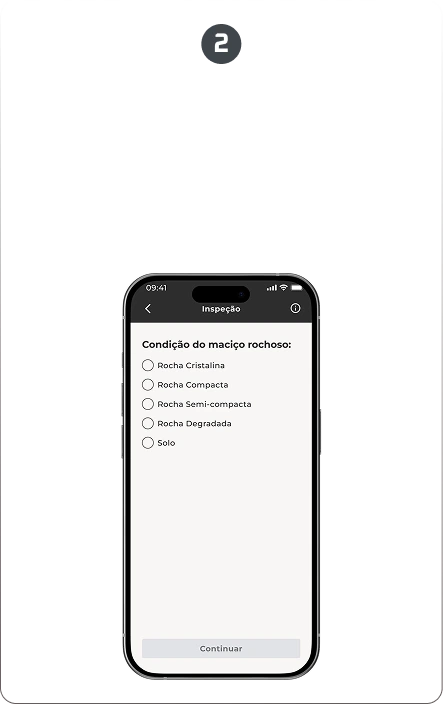
Technical field
Structured collection of inspection data, such as rock mass condition.
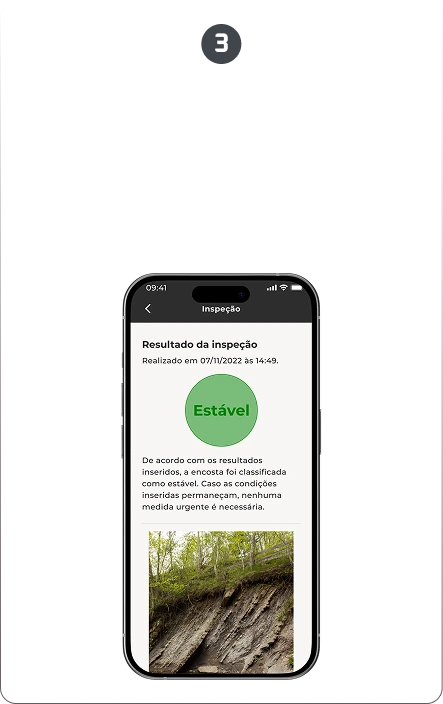
Classification
The system classifies the risk automatically and supports decision-making.
THE RESULT
Combining precise geolocation, AI analysis and an intuitive field interface, we turned Sentinela into the official reference of Minas Gerais Civil Defense for disaster prevention. Every feature was designed to save lives, with pioneering recognition in urban slope monitoring.